
Neapolitan vs Roman pizza: how to tell them apart
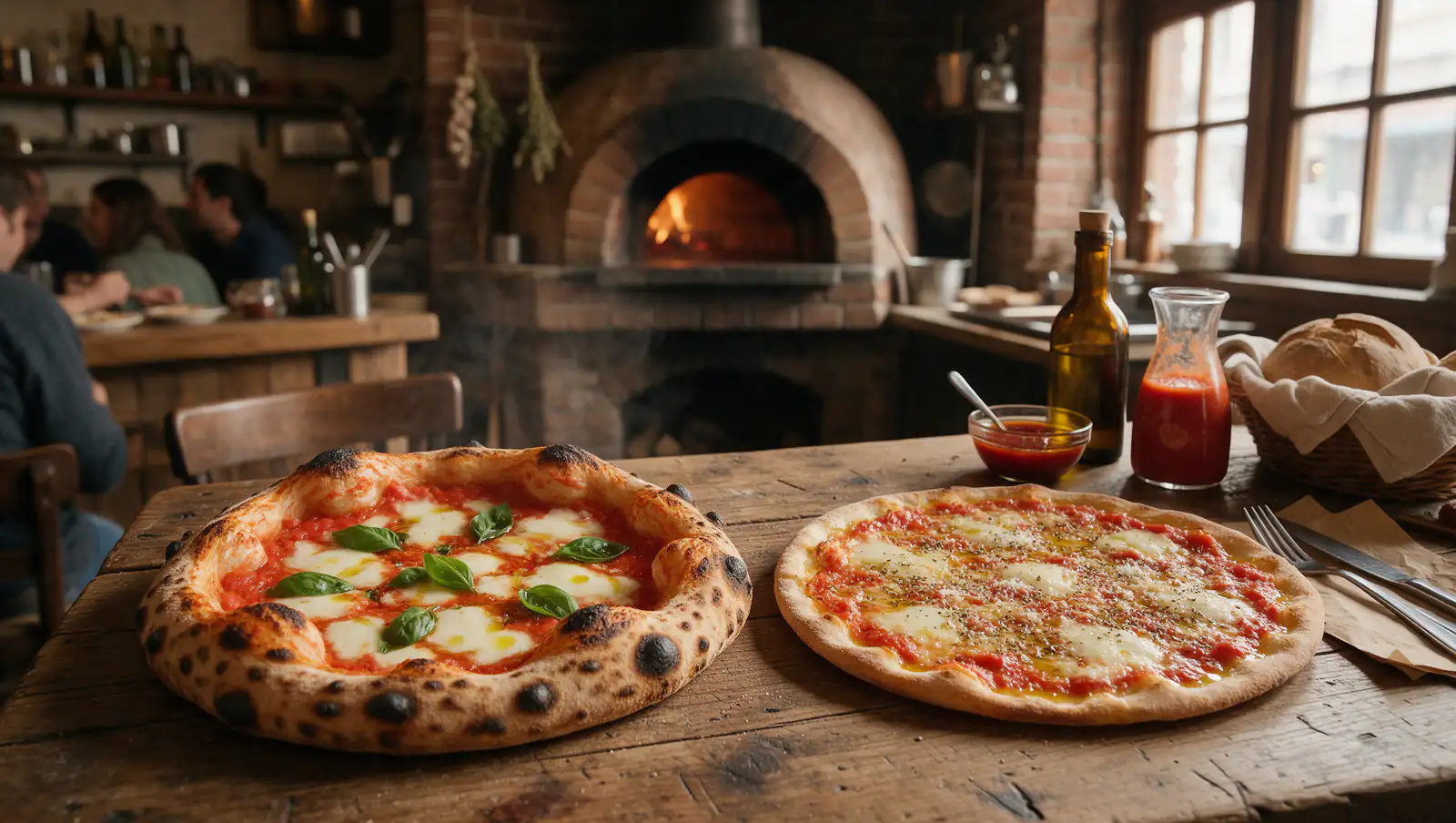
Italy's two best-known pizza styles come from cities only a little over two hours apart by road, yet they could hardly be more different. Neapolitan pizza is soft, chewy and puffy at the edge. Roman pizza is thin, flat and crisp enough to crackle when you bite it.
The fastest way to tell them apart is to look at the rim. A tall, airy, leopard-spotted edge means Neapolitan. A barely raised edge and a cracker-like base that holds its shape when you lift a slice means Roman. Everything else, from the dough to the oven, follows from that difference.
Here is what to look for, why the two styles turn out the way they do, and how to order and eat each one.
The quick side-by-side
| Neapolitan | Roman (tonda) | |
|---|---|---|
| Edge | Tall, puffy cornicione with charred spots | Thin, little or no raised rim |
| Base | Soft and thin in the center, folds easily | Thin and crisp throughout |
| Shaping | Stretched by hand only | Often rolled out with a rolling pin |
| Dough | Flour, water, salt, yeast | Usually adds olive oil |
| Bake | Very hot oven, about 60 to 90 seconds | Cooler oven, a few minutes |
| Texture | Chewy, moist, tender | Crunchy, dry, crackly |
These are the traditional versions. Modern pizzerias in both cities play with the rules, so treat the table as a guide to the classic styles rather than a description of every pizza you will meet.
A few other clues help when the pizza is already on the table. Lift the edge of a slice: a Neapolitan one bends and the tip flops down, while a Roman one stays almost straight. Look underneath: Neapolitan bases are pale with scattered dark spots, Roman bases are more evenly golden. And listen as it is cut. A Roman tonda crackles under the knife or wheel, a Neapolitan pizza makes almost no sound at all.
Neapolitan pizza: soft, puffy and quick
Neapolitan pizza is defined by its cornicione, the raised rim that puffs up in the oven and develops dark blistered spots. The center is thin and soft, and with a good amount of tomato and mozzarella it can be quite wet. That is intentional, not a fault. The cheese is usually fior di latte (cow's milk mozzarella) or buffalo mozzarella, added in pieces rather than grated, so it melts into soft pools instead of an even layer.
The style is protected in the European Union as a Traditional Speciality Guaranteed (TSG, or STG in Italian), and the rules give a good picture of what to expect:
- The dough is only flour, water, salt and yeast, with no oil or sugar.
- It is shaped by hand, pressing air from the center toward the edge. Rolling pins and machines are not allowed.
- The finished pizza is no more than about 35 cm (14 inches) across.
- It bakes in a wood-fired oven at very high heat, roughly 430 to 485°C (about 800 to 900°F), for around 60 to 90 seconds.
That fast, fierce bake is why the edge balloons and chars while the middle stays tender. In recent years a "contemporary" Neapolitan style with an even larger, airier rim has become popular. Whether it improves on the classic or drifts from it is a lively debate among pizza makers.
For the history of the style and the origins of the margherita, see our guide to la vera pizza and how to recognize it.
Roman pizza: thin, flat and crisp
Roman round pizza, called pizza tonda, is the opposite approach. Romans often describe a good one as scrocchiarella, a dialect word for something that crunches. The dough is usually stretched very thin, often with a rolling pin, so there is almost no rim at all.
Several things produce that texture:
- Olive oil is commonly added to the dough, which helps it crisp and brown.
- The dough is rolled flat, which presses out the air that would otherwise make the edge rise.
- It bakes at a lower temperature than Neapolitan pizza and for longer, often a few minutes, which dries the base until it is firm.
The result is a pizza you can pick up by the slice without it drooping. Toppings tend to be spread right to the edge, since there is no puffy rim to frame them.
Beyond the round: pizza al taglio and pizza bianca
In Rome, much of the pizza people eat during the day is not round at all. Pizza al taglio (pizza by the cut) is baked in large rectangular trays, cut with scissors into whatever size you ask for, and usually sold by weight. Many modern versions use a very wet dough and long fermentation, giving a crust that is crisp underneath and open and airy inside, quite different from the thin tonda.
Pizza bianca is the simplest of all: dough brushed with olive oil and sprinkled with salt, sold in bakeries in long sheets. Romans often split it and fill it with mortadella. It sits somewhere between pizza and flatbread, a distinction we explore further in focaccia vs. pizza.
Naples has its own street versions too, such as fried pizza (pizza fritta) and the small folded pizza eaten on the go, often called a portafoglio (wallet) because it is folded in four.
How to order and eat each style
- In Naples, a pizza is usually one per person and comes uncut. Many locals eat it with a knife and fork, especially the soft center, or fold slices in half. The classics to start with are the margherita and the marinara (tomato, garlic, oregano and olive oil, no cheese).
- In Rome, round pizza is mostly an evening meal at a pizzeria. It is common to start with fried snacks such as supplì (fried rice croquettes) or battered zucchini flowers. Toppings to look for include zucchini flowers with anchovy and the capricciosa, though the combination varies from place to place.
- Pizza al taglio is daytime food. Point at the tray, say how big a piece you want, and it is weighed, reheated if you like, and handed over to eat standing up.
Neither style is better. They are built for different pleasures, and the best plan is to try both in their home cities.
Learn to make both
Making each style yourself is the clearest way to feel the difference, from a soft hand-stretched dough to a thin rolled one. In Naples, our guide to Naples cooking classes includes options focused on pizza, and in the capital you can learn the local style with pizza-making classes in Rome. For classes across the country, see the best pizza-making classes in Italy, or practice at home first with our pizza margherita recipe.
Frequently asked questions
Can I make Neapolitan pizza in a home oven?
You can make a good pizza in the Neapolitan spirit, but a standard home oven tops out well below the heat a wood-fired oven reaches, so the bake takes longer and the rim will not char the same way. A preheated pizza steel or stone on the top rack, with the broiler on, gets you closer.
Which style is easier to make at home?
Roman-style thin pizza is usually more forgiving, because it is designed for a cooler oven and a longer bake. A rolling pin also makes shaping easier for beginners than hand-stretching a soft Neapolitan dough.
Is New York pizza closer to Neapolitan or Roman pizza?
Neither exactly. New York pizza descends from Neapolitan immigrant pizza makers but is larger, baked longer in gas or coal ovens, and sturdy enough to fold and eat by the slice. Its texture sits between the soft Neapolitan and the crisp Roman styles.
Why is the center of a Neapolitan pizza wet?
The base is thin, the bake is very short, and fresh tomato and mozzarella release moisture as they heat. A slightly soupy center is normal and expected for the style. It is one reason many people in Naples eat the middle with a knife and fork.
- Naples
- Rome
- Food guide
- Pizza