
Parmigiano, prosciutto and balsamic: Emilia-Romagna's food valley
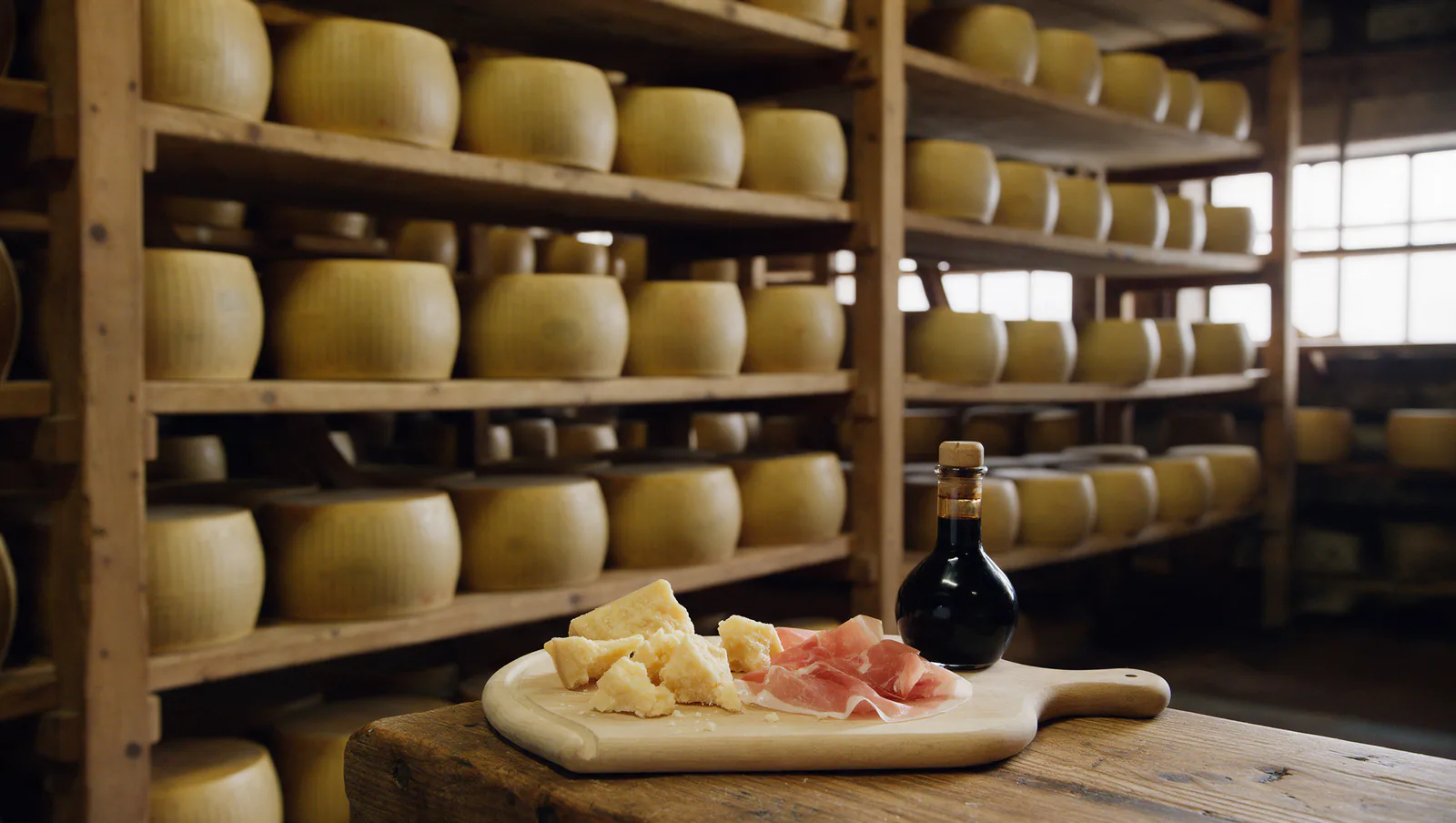
Parmigiano Reggiano, Prosciutto di Parma and traditional balsamic vinegar all come from the same small part of Emilia-Romagna, in the plain and foothills between Bologna and Parma. The area is often called Italy's Food Valley, and for a food-focused traveler it is one of the easiest places in the country to see famous products made from start to finish, usually within an hour of a train station.
Each of the three is protected by strict production rules, and each takes time: at least a year for the cheese and the ham, at least twelve years for the traditional vinegar. Understanding how they are made helps you read the labels, avoid imitations and get far more out of a visit.
Below we cover each product, what to expect on a producer visit, and how to fit it all into a trip.
Where the food valley is
The heart of the area runs along the Via Emilia, the old Roman road that still links Bologna, Modena, Reggio Emilia and Parma in a nearly straight line. Regional trains connect these cities, and Bologna to Parma takes roughly an hour. The Apennine foothills rise to the south and the flat plain of the Po river stretches to the north.
Each city has its own specialties, but they share a cooking style built on fresh egg pasta, pork, butter and aged cheese. Bologna has tagliatelle with ragù, tortellini and mortadella. Modena has balsamic vinegar and Lambrusco. Parma, named a UNESCO Creative City of Gastronomy in 2015, has its ham and is close to the heart of Parmigiano country. If you want to understand the cooking of the region, a city like Bologna is the natural base, and the dish most people associate with it is a good place to begin at home: see our lasagna Bolognese recipe.
Parmigiano Reggiano: milk, salt, rennet and time
Parmigiano Reggiano is a DOP (protected designation of origin) cheese, which means it can only be made in a defined area, following a fixed set of rules. That area covers the provinces of Parma, Reggio Emilia and Modena, plus parts of Bologna and Mantua.
The ingredients are just raw cow's milk, salt and rennet. No additives are allowed. Milk from the evening milking is left to rest so the cream rises and can be partly skimmed, then mixed with whole milk from the morning. The milk is heated in large copper vats, the curd is broken into tiny grains, cooked, and lifted out in a cloth. Each vat gives two large wheels, typically around 40 kg (about 88 lb) each once aged.
The wheels are marked with the dotted Parmigiano Reggiano lettering around the rind, soaked in brine for a few weeks, then aged on tall wooden shelves. At about twelve months, each wheel is inspected and tested. Wheels that pass are fire-branded. The minimum age is 12 months, and you will commonly see it sold at different ages:
- Around 12 to 18 months: milder, softer and milky, good for eating in chunks.
- Around 24 months: the classic all-rounder, for grating and for the table.
- 30 to 36 months and beyond: drier, more crumbly and savory, with crunchy crystals.
"Parmesan" sold outside Europe is not necessarily Parmigiano Reggiano. Look for the name and the dotted lettering on the rind.
Prosciutto di Parma: only pork and sea salt
Prosciutto di Parma is a DOP ham made in the hills south of Parma, with the town of Langhirano often seen as its center. The rules allow only two ingredients: legs from pigs raised in a defined area of Italy, and salt. No nitrates, nitrites or other preservatives are added.
The process takes at least a year. The legs are salted and rested in cold rooms, washed, then hung to air-dry. The open face of the meat is covered with a paste of lard, salt and flour to stop it drying out too fast. Traditionally the hill climate, with its dry breezes, played a big part in the curing, and producers still describe it as important. Finished hams are tested by inserting a thin bone needle into several points and smelling it, then branded with the five-pointed ducal crown.
Nearby, in the foggy lowlands near the Po, you will also find culatello di Zibello DOP, a prized cured cut from the hind leg, aged in damp cellars. It is worth tasting if you see it on a menu.
Prosciutto is at its best sliced very thin and eaten at room temperature, on its own or with bread, melon or a chunk of Parmigiano.
Balsamic vinegar: tradizionale vs the everyday kind
Balsamic vinegar causes more confusion than the other two, because two very different products share the name.
| Traditional balsamic (DOP) | Balsamic vinegar of Modena (IGP) | |
|---|---|---|
| Ingredients | Cooked grape must only | Grape must and wine vinegar, some caramel allowed |
| Minimum aging | 12 years; 25 years for extravecchio | 60 days; 3 years for invecchiato |
| Made in | Modena or Reggio Emilia | Provinces of Modena or Reggio Emilia |
| Texture and use | Thick, sweet-sour; a few drops at a time | Thinner; dressings, cooking, glazes |
The traditional DOP versions, Aceto Balsamico Tradizionale di Modena and Aceto Balsamico Tradizionale di Reggio Emilia, start with grape must that is slowly cooked down. It is then aged for years in a series of barrels of decreasing size and often different woods, known as a batteria. Each year a little vinegar is drawn from the smallest barrel, and each barrel is topped up from the next larger one. Many families keep their barrels in the attic, where hot summers and cold winters help the process along.
Traditional balsamic is sold in small bottles, usually 100 ml, and is expensive because of the time involved. The IGP version is the one you find in supermarkets worldwide. It can be very good for everyday use, and quality varies widely, so the aging information on the label is worth reading.
Visiting producers
Producer visits are the main reason many people come to the area. A few practical points help:
- Book ahead. Most dairies, ham producers and vinegar makers are working businesses and take visitors by appointment or through organized tours.
- Go early for cheese. Parmigiano is made in the morning, so dairy visits typically start early, often around 8 or 9 am, to see the curd being lifted from the vats. Later visits may only show the aging rooms.
- Expect closed days. Some producers do not take visitors on Sundays or holidays, and August can be quieter.
- Consider transport. Many dairies and ham producers are in the countryside, so a guided tour or a car makes visits much easier than public transport.
- Think about packing. Vacuum-packed cheese and sealed products are easier to travel with. Check your home country's customs rules on meat and dairy before you buy.
A common plan is a full-day tour that visits a dairy in the morning, a balsamic maker before lunch and a ham producer in the afternoon, often with a Lambrusco tasting along the way. If wine is part of the trip, our guide to the best wine tasting tours in Italy covers options across the country.
Cook it where it comes from
The best way to finish a food valley trip is in a kitchen, rolling the egg pasta that all of these ingredients were made to go with. Our ranked guides to cooking classes in Bologna, Modena cooking classes and Parma cooking classes cover the three main bases, and our overview of cooking classes in northern Italy helps if you are combining Emilia-Romagna with other regions.
Frequently asked questions
How many days do I need for the food valley?
Two or three days is enough for producer visits and a cooking class from a single base. Bologna is the most convenient base for trains, while Parma or Modena put you closer to dairies and producers.
Is Grana Padano the same as Parmigiano Reggiano?
No. Grana Padano is a separate DOP cheese made across a much larger area of northern Italy under different rules, including a shorter minimum aging period. It is similar in style and usually cheaper, but it is a different cheese.
Can I bring Parmigiano and prosciutto home to the US?
Hard aged cheese such as Parmigiano Reggiano is generally allowed if declared, while rules on cured meats are stricter. Check the current guidance from US Customs and Border Protection or your own country's authority before buying.
Is Parmigiano Reggiano vegetarian?
Not strictly, because it is made with animal rennet as the rules require. Some vegetarians eat it and others avoid it, and you will find cheeses made with non-animal rennet labeled as such, though they cannot be called Parmigiano Reggiano.
- Parma
- Modena
- Emilia-romagna
- Cheese
- Food tours