
Carbonara, cacio e pepe, amatriciana and gricia: Rome's four pastas
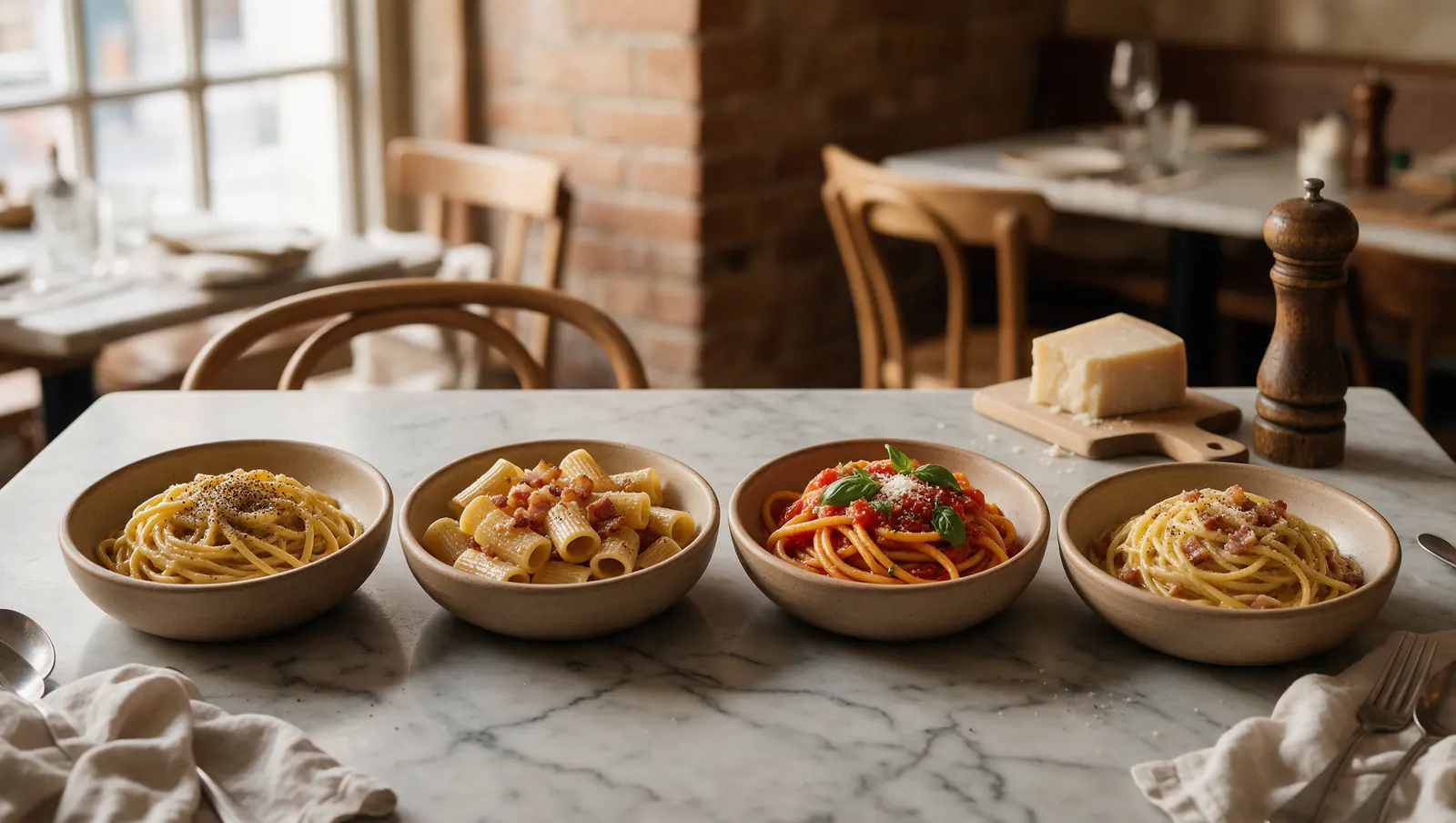
Order pasta in a Roman trattoria and four dishes come up again and again: carbonara, cacio e pepe, amatriciana and gricia. They are often called the four Roman pastas, and they are closely related. Three of them are built on guanciale (cured pork cheek), and all four rely on Pecorino Romano and black pepper.
The simplest way to tell them apart: cacio e pepe is just pecorino and pepper; gricia adds guanciale; amatriciana is gricia with tomato; carbonara is gricia with egg. Once you see them as a family, the menu makes sense.
Below we explain each dish, the debates around them, and how to make them at home in quantities for two.
The shared pantry: guanciale, pecorino and pepper
The quality of these dishes depends almost entirely on three ingredients, so they are worth understanding.
- Guanciale is pork cheek cured with salt, pepper and sometimes herbs. It has more fat than pancetta and a deeper, slightly funky flavor. When cooked slowly, the fat renders into the pan and becomes part of the sauce. Pancetta is the usual substitute outside Italy. Smoked bacon works in a pinch but changes the character of the dish.
- Pecorino Romano is a hard, salty sheep's milk cheese with DOP status. Despite the name, much of it is made in Sardinia, which is within the protected production area along with Lazio and the province of Grosseto. Grate it finely so it melts smoothly.
- Black pepper should be freshly and fairly coarsely ground. Toasting it briefly in a dry pan brings out its aroma.
Because pecorino and guanciale are both salty, salt the pasta water more lightly than usual.
How the four compare
| Dish | Key ingredients | Classic pasta |
|---|---|---|
| Cacio e pepe | Pecorino, black pepper, pasta water | Tonnarelli or spaghetti |
| Gricia | Guanciale, pecorino, black pepper | Rigatoni or spaghetti |
| Amatriciana | Guanciale, tomato, pecorino, chili, often white wine | Bucatini or spaghetti |
| Carbonara | Guanciale, egg, pecorino, black pepper | Spaghetti or rigatoni |
The pasta shapes are common choices, not strict rules. You will find each sauce on several shapes around Rome.
Gricia: the quiet original
Gricia is the least known abroad, but many Romans consider it the ancestor of amatriciana, and it is often described as amatriciana without the tomato. Like many food origin stories, this one is debated. The name is also disputed: one popular theory links it to Grisciano, a village near Amatrice, while others connect it to an old Roman nickname for grocers and bread sellers.
To make it for two: cut 100 g (3.5 oz) guanciale into short strips and cook it slowly in a dry pan over medium-low heat until the fat renders and the edges turn golden, about 8 to 10 minutes. Cook 200 g (7 oz) rigatoni or spaghetti until just short of done. Move the pasta into the pan with a ladle of cooking water and toss over low heat. Off the heat, add about 50 g (1.75 oz, roughly 2/3 cup finely grated) pecorino and plenty of pepper, tossing and adding splashes of water until the fat, water and cheese turn into a glossy sauce.
Amatriciana: the one with tomato
Amatriciana takes its name from Amatrice, a mountain town in northern Lazio that belonged to Abruzzo until 1927, which is why both regions feel some ownership of it. The recipe promoted by the town uses spaghetti, guanciale, white wine, tomatoes, chili and pecorino, with no onion or garlic. In Rome, bucatini is the classic shape, and some Roman cooks add onion. Whether onion belongs is one of the longest-running arguments in Italian cooking, so expect to meet both versions.
To make it for two: render 100 g (3.5 oz) guanciale as for gricia, then lift out the crisp pieces and set them aside. Add a pinch of dried chili and a splash of dry white wine to the fat and let it bubble off. Add 400 g (14 oz) canned peeled tomatoes, crushed by hand, and simmer for about 15 minutes until thickened. Return the guanciale, toss with 200 g (7 oz) bucatini or spaghetti cooked just short of done, and finish with about 40 g (1.5 oz) grated pecorino.
Carbonara: the one with egg
Carbonara is the most famous of the four and the youngest. It does not appear in print until after World War II, and its origin is genuinely uncertain. Theories range from charcoal burners (carbonari) in the Apennines to the idea that Allied soldiers' rations of bacon and powdered egg inspired Roman cooks. None is proven.
What Romans do agree on: no cream, no garlic, no peas. The creaminess comes entirely from egg, cheese and pasta water. Some cooks use only yolks, others a mix of yolks and whole eggs, and some blend pecorino with Parmigiano Reggiano for a milder flavor.
To make it for two: render 100 g (3.5 oz) guanciale until crisp at the edges, then turn off the heat. In a bowl, whisk 3 egg yolks and 1 whole egg with 50 g (1.75 oz, roughly 2/3 cup finely grated) pecorino and lots of pepper. Toss 200 g (7 oz) cooked spaghetti or rigatoni in the guanciale and its fat, let it cool for about 30 seconds, then add the egg mixture and a splash of pasta water and toss quickly. The eggs should thicken into a sauce without scrambling. If it stays runny, return the pan to very low heat for a few seconds while stirring.
Cacio e pepe: the hardest easy dish
Cacio e pepe means "cheese and pepper", and that is the whole recipe, plus pasta water. Its simplicity is the challenge: if the cheese gets too hot, it clumps into strings instead of becoming a smooth cream. It is traditionally served on tonnarelli, a fresh square-edged pasta similar to spaghetti alla chitarra, though dried spaghetti is common.
To make it for two: finely grate 100 g (3.5 oz, about 1 1/4 cups) pecorino. Toast 1 to 2 teaspoons coarsely ground pepper in a dry pan, then add a ladle of pasta water. Cook 200 g (7 oz) pasta in less water than usual so the water gets starchy. In a bowl, stir the pecorino with a few tablespoons of warm (not boiling) pasta water into a thick paste. Toss the drained pasta in the pepper pan for a minute, take it off the heat and let it cool slightly, then add the cheese paste and toss hard, adding water a spoonful at a time until creamy. Patience with temperature is the whole secret.
Eating and learning them in Rome
In Rome these pastas are a first course (primo), often followed by a meat dish such as saltimbocca alla romana. Ordering two or three to share and comparing them is a good way to taste the family resemblance.
If you want to learn the technique, especially the timing of the egg in carbonara and the temperature control in cacio e pepe, a hands-on class helps more than any recipe. See our guides to cooking classes in Rome and pasta-making classes in Rome, many of which teach tonnarelli and one or more of these sauces. For a day out of the city, a winery tour from Rome pairs well with a pasta lunch.
Frequently asked questions
Can I make carbonara with pancetta or bacon?
Yes, and many people outside Italy do because guanciale can be hard to find. Unsmoked pancetta is the closest substitute. Smoked bacon makes a tasty dish but with a noticeably different flavor, so Romans would not call it a traditional carbonara.
Is Parmigiano Reggiano allowed in these dishes?
Pecorino Romano is the traditional cheese for all four. Some cooks mix in Parmigiano Reggiano, especially in carbonara, for a softer, less salty result. It is a matter of taste, though using only Parmigiano moves the dish away from its Roman roots.
Which of the four is best for vegetarians?
Cacio e pepe, since it contains no meat. Traditional Pecorino Romano is made with animal rennet, so strict vegetarians may want to check the cheese label or ask at the restaurant.
Why does my cacio e pepe turn lumpy?
Usually because the pan or the water is too hot when the cheese goes in, which makes the proteins seize. Grate the cheese very finely, mix it into a paste with warm water first, and add it off the heat. Using pasta water with plenty of starch also helps it emulsify.
- Rome
- pasta
- Lazio
- Recipes